


Answering Service vs AI vs In-house
Live Customer Service vs AI Receptionist
For the past 100 years, up until the past few years, the choice was fairly clear: if you needed phone support, you could hire a receptionist or an answering service to answer calls, assist customers with booking appointments, or schedule service for your business.
For most of that time, customers understood that many companies and services were only available during typical office hours. Businesses relied on referrals or, back in the day, the Yellow Pages to connect with new customers. Customers were willing to wait for good service back then.
Today, small businesses are presented with an array of options for marketing, SEO, social media, and more. Customers now expect immediate service, and if they cannot get it, they will move down the list until they find someone to speak with when they have an urgent need. Add in the fact that the cost of everything has risen sharply over the last few years, and you can see why comparing options matters so much. If you want a faster estimate for your business, try our cost calculator.
The Case for the Human Touch: Empathy as a Premium Product
In 2026, human connection has become a luxury good. As the world becomes more automated, the sound of a warm, empathetic human voice has become a powerful brand differentiator. Consumers still appreciate the nuance and being able to have a real conversation to explain the issue they are having, whether it is an issue with their AC unit when it is 100 degrees in the summer, they are worried about the legal situation they are facing, or their kids’ health. Regardless of how good AI gets, there will always be a need for human touch.
Live receptionist support goes beyond getting just the facts of the situation. It builds trust. Empathy goes a long way toward retaining customers and getting repeat business, even if it is not as efficient as a computer at getting the facts. Humans possess high-context intelligence and offer creative problem solving when the information being provided does not fall into a neat category or field. They can escalate the call to the owner or a decision maker to ensure the caller gets what they need in a timely manner. They can slow down and take their time if they are dealing with an elderly person that needs something more.
For industries like healthcare, home services, law, and property management, trust is the primary currency. A SurveyMonkey study from late 2025 revealed that 79% of Americans still strongly prefer interacting with a human for sensitive or urgent issues. When a client is calling a family law firm, they are not just looking for an appointment; they are looking for validation. An AI might be efficient, but it cannot feel for the client. Customers may accept the fact that this may be what they have to deal with in an AI future, but that does not mean they like it.
The AI Revolution: The End of the Waiting
Traditionally, customers understood it might take some time to get to speak with someone if they had an urgent problem, unless of course that company used an answering service. Today consumers shop at midnight via an app on their phone. They expect someone to respond at 6 a.m. on Sunday when they have a problem with their hot water heater. AI receptionists are able to capture leads 24/7. AI is never sick and never takes a vacation.
The Financial Reality: An 80+% Cost Reduction?
The biggest driver of AI adoption is savings. A qualified full-time receptionist can cost over $50,000 a year when you add up payroll taxes and benefits. In contrast, the cost of AI can be as little as $300 a month. To get a better idea of what live answering or call coverage may cost for your business, use our cost calculator.
However, there are tradeoffs between AI and live reception. One of the primary fears of AI in business is hallucinations and the fact that some AI systems may make up facts. Those systems also need to be updated as new services emerge or pricing changes. It is not set it and forget it. You should still spot check and test the system regularly to ensure it is running properly.
This is not to say that humans do not require ongoing training, but often you can tell your receptionist on a moment’s notice not to take any more appointments for the day so you can make your kid’s soccer game that afternoon. For AI systems to be completely self-sufficient, you need to connect them to your booking system as well.
What does AI excel at?
What can you do with AI without alienating customers? It largely depends on focusing on routing interactions, having it communicate information like what areas your home service company covers, verifying an appointment they already have booked, and collecting simple information like names, numbers, and addresses before connecting with a real person. The rigidity of those activities can be helpful and time-saving for your team.
For many businesses, the better fit is not AI alone, but AI supported by a professional answering service that can take over when the conversation becomes more urgent, emotional, or complex.
Consumer Sentiment: The Great Paradox
The data on how consumers feel about AI is a study in contradictions. While people say they prefer humans, their behavior suggests they prefer speed.
A 2026 Pega/YouGov survey found that:
- 81% of people believe AI is used primarily to save the company money, not to help the customer.
- 73% of customers would take their business elsewhere if a company only offered AI with no way to reach a human.
Again, when the task is simple, like checking an order status or booking a haircut, 51% of consumers actually prefer a bot because it is faster. The frustration does not come from the AI itself; it comes from bot dead-ends, where a user gets stuck in a loop with no escape to a human agent. It does not replace the need for employees to connect to customers, especially when they have complex needs.
The Winner: The Hybrid Model
For businesses exploring a hybrid model, our cost calculator can help estimate monthly costs before requesting a quote. The most successful businesses in 2026 have moved away from the either/or debate. Instead, they use a hybrid model.
In this scenario, an AI answering service acts as the first line of defense. It handles routine inquiries, FAQs, and appointment scheduling. If the AI detects high emotion, complex technical jargon, or a VIP caller, it seamlessly warm-transfers the call to a human specialist. This allows human staff to stop doing low-value tasks like giving out directions and focus on high-value tasks like closing sales and solving crises.
Choose a Live Receptionist if:
- You are in a high-stakes, high-emotion industry such as crisis counseling, estate law, or healthcare.
- Your brand is positioned as a high-touch luxury service.
- Your call volume is low enough that one person can handle it personally.
- You deal with urgent issues where the caller needs reassurance that the expert will follow up quickly, like plumbing, HVAC, and contractor services, where the consumer may be spending thousands of dollars and your business cannot afford to lose an opportunity.
Choose an AI Receptionist if:
- You have high call volumes with routine, repetitive questions.
- You operate in multiple time zones or require 24/7 coverage.
- You are a small business or startup where every dollar of overhead counts.
- You want to give employees easy access to making routine requests or updating information without the need to speak to HR.
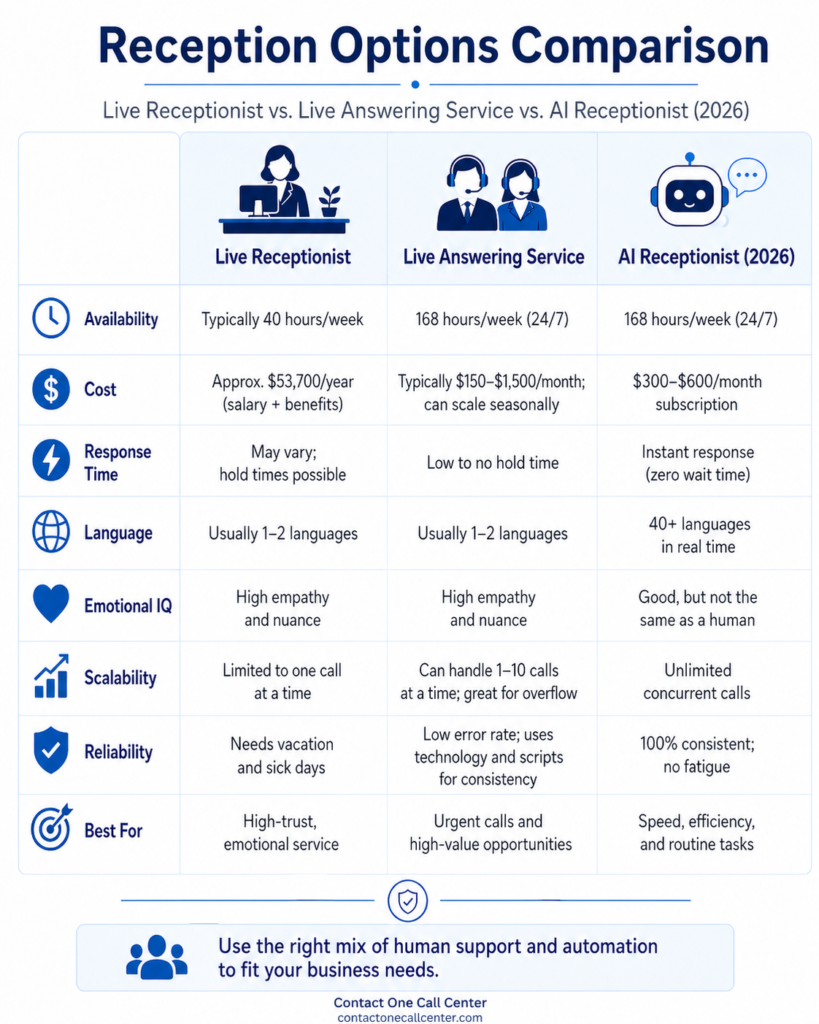
Combine AI and In-House Reception with a Live Answering Service
After 45 years in the customer support industry, and running a 24/7 answering service, the best of both worlds are available to businesses. That is to combine AI with an after-hours answering service and your front office team. Use AI for the options outlined above. When your team is unavailable during the day, have the virtual receptionist or answering service act as your backup for live answering. With the right tools, you can handle routine questions and escalate to the after-hours team to ensure your customers have 24/7 access to a real person.
This will build trust and repeat business by focusing on high-value opportunities. When customers want that human touch, it will be available, creating a low-friction environment for clients.
This is especially true in industries like physician answering services, law firm phone answering services, and property management, where speed matters, but empathy and accuracy still drive retention.
The fact remains: 68% of customers expect brands to demonstrate empathy in every interaction. AI still fails the empathy test during high-stress after-hours calls, like medical or insurance claims, where a human’s ability to say, “I’m so sorry you’re going through this; let me help,” cannot be replicated.
Give your business the ability to retain and obtain more customers by keeping your answering services fast and efficient, while also giving callers the opportunity to have a personal conversation with a human. To see what the right setup may cost, try our cost calculator. For more ideas on blending automation, live support, and industry-specific workflows, explore the Contact One blog.